
The chameleon changes its coloration depending on the situation.
OVERVIEW
IDEA
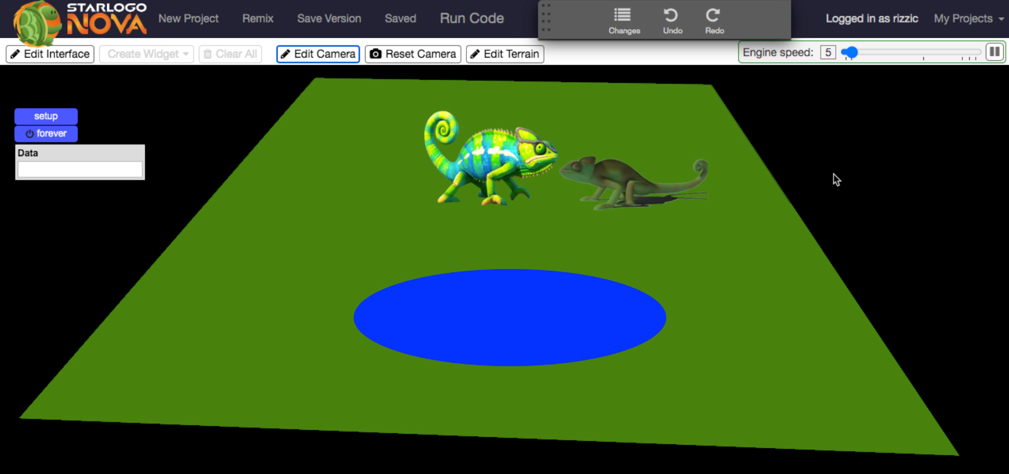
Model how chameleons change their color depending on situations. If they get angry they turn red and yellow, if they want to court a female they turn purple.
CONTENTS
Collisions - Sniffing - Breeds
MODEL
Place different agents: male and female chameleons (green) and some predator. Males are larger in size than females. Have them wander randomly and when a male and female meet the male turn purple and when a female or a male is found with a predator nearby they turn reddish or yellow randomly.
OTHER SOURCES
Stimulation #1: The chameleon changes its coloration depending on the situation
 Popular culture often uses the nickname “chameleon” pejoratively to label people who have the ability to camouflage themselves, to blend in with the environment to go unnoticed at critical moments. This cultural trait has its roots in the phenomenon that different species of chameleons change their skin color depending on the situation. For example, the panther chameleon, one of the two hundred known species of chameleons, when young, changes its skin color, blending in with the environment, which helps it escape from its predators. This color change is due to the presence of nanocrystals in your skin cells that cause this effect when light falls on them. When two male panther chameleons confront each other, they change their coloration to a defiant yellowish red, just as when they are in the presence of a predator. On the other hand, to court a female (in the case of males), the panther chameleon, whose color is normally green or brown, dresses in his best pink clothes to impress her. In reality, this peculiarity of chameleons is a physiological reaction used as a form of communication. In addition to changing their coloration, chameleons can also change their appearance to appear larger in competitive situations. In normal situations, males are larger than females. As predators, chameleons have interesting machinery: a very long tongue, incredibly fast and extremely sticky to catch their prey, as well as eyes that protrude from their sockets, rotate 360 degrees and move independently. Almost 40% of the known chameleon species live in Madagascar and their natural predators are birds and snakes.
 Sources
“Colorful Language,” by Patricia Edmonds (2015). National Geographic.
Este
es
Simulation párrafo#1: donde lo que se escribe es como si estuviera grabado en piedra debidoRepresent a lascene longitudin delthe texto,country cuantoof máMadagascar where the characteristic of the male panther chameleon's escribimoscolor máschange necesitamosis delvisualized espacio.in different situations: courtship with a female, confrontation with a predator, and competition against another male.
 Curricular connections